 Bouquets · DIY kits
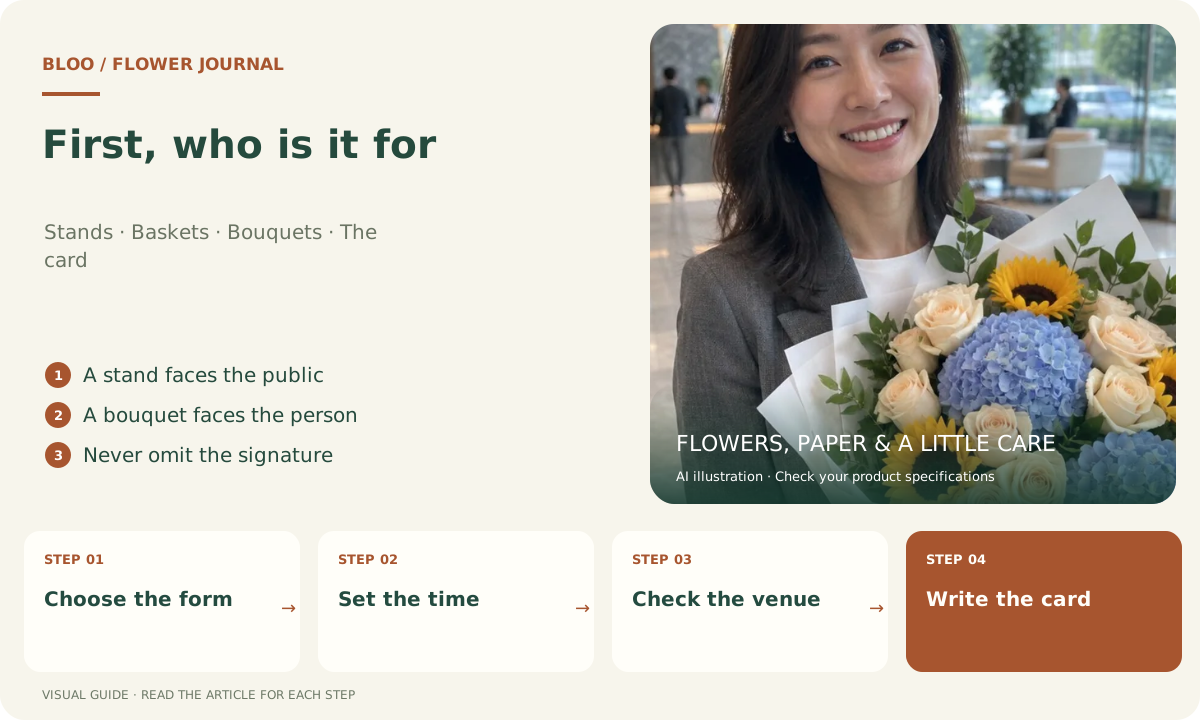
Congratulations come in three common forms. Stands and baskets are large, sit at a shop entrance or in a lobby, and exist so that passers-by see the show of support — they suit a company sending in its own name. A congratulations bouquet is small, goes into someone’s hands or sits indoors, and suits a personal gesture or a venue with no room. Delivery should land before the opening ceremony, usually that morning or the evening before. A card needs three things: the congratulation, who it is for, and who it is from — and the third is the one most often left out. BLOO supplies congratulations bouquets rather than large stands.
First, who is it for
Stands · Baskets · Bouquets · The card
- 01
Choose the form
Is it for passers-by, or for them
- 02
Set the time
It must arrive before the ceremony
- 03
Check the venue
Building management may not allow it
- 04
Write the card
The congratulation, who for, who from
Check before continuing: BLOO supplies congratulations bouquets. It does not make large opening stands or floor-standing baskets.
Stands, baskets and bouquets are three different things
What separates them is not price but who they are for. Stands and baskets are large, stand at an entrance or in a lobby, and exist so that people walking past can see how many well-wishers there were — they face the public. A congratulations bouquet faces the recipient, and goes on a desk or home with them. Once that is clear the choice is straightforward.
To be plain: BLOO supplies congratulations bouquets and does not make large opening stands or floor-standing baskets. If what the occasion calls for is the display at the door, that is a job for a florist who specialises in them. The use of this guide is to help you work out which one you need, not to steer you towards the one we make.
| Form | Where it goes | Who it is for | Suits |
|---|---|---|---|
| Stand | A shop front or outside a lobby | Passers-by | A shop opening, a company launch, a large event. |
| Basket stand | At the door or inside a lobby | Guests arriving | An opening reception, an office move. |
| Bouquet | A desk, a meeting room, or home | The recipient themselves | A personal gesture, a small space, a promotion or an award. |
When it should arrive
There is one simple principle: it should be there before the ceremony starts. Stands and baskets normally arrive on the morning of the opening, or are set up the evening before. Arriving late is the awkward outcome — the guests have gone and a stand appears at the door, at which point it is no longer congratulating anything.
A bouquet is more flexible, though it should still land on the day or within a day or two after, with the recipient confirmed to be there. If they will be occupied with guests on the day itself, sending to their office is more practical than sending to the venue.
Venue limits: ask, do not assume
Shopping centres, office buildings and some commercial premises have explicit rules about stands and baskets at entrances. Some forbid them entirely; others limit the size or how long they may stay. Those rules come from building management, not from the business itself — which means the recipient can welcome your flowers and management can still turn them away. Before ordering, have the recipient check with management.
The other thing that trips people up is removal. Stands and baskets are usually collected by the florist after the event, but some venues require same-day clearance. Without a collection arranged, the recipient ends up disposing of a large structure themselves — which is a chore rather than a gift.
What to write on the card
A complete card carries three things: the congratulation, who it is for, and who it is from. The third is the one most often missing. There may be ten stands at a door on opening day, and without a name the recipient has no idea whom to thank. It is the most common and most avoidable mistake.
Company and personal cards are worded differently. A company uses its full registered name, optionally with a title. An individual uses their name, or just a first name where the relationship allows. If you are sending on behalf of a team, "the marketing department at such-and-such" is more accurate than one person’s name.
| Situation | Congratulation | How to sign |
|---|---|---|
| A shop opening | Best wishes for a successful opening | The full company name, or "everyone at [company]". |
| A company launch | Congratulations on the launch, and every success ahead | Company name with a title. |
| An office move | Congratulations on the new premises | Company or personal name. |
| A promotion or award | Thoroughly deserved — congratulations | Your name, or just a first name if you are close. |
Sending as a company and sending as yourself
A company card is about being seen. Stands and baskets are made large precisely so they can be picked out among the others at a door. In that case the legibility of the name matters far more than the flowers: the size of the lettering and whether the company name is spelled correctly are worth checking before the material is.
A personal card is the opposite: it is about being remembered. A bouquet on a desk with one specific line — how long they have been working towards this, the conversation where they first mentioned the idea — outlasts any four-character formula. For that, a bouquet beats a stand comfortably.
Congratulations other than openings
A congratulations bouquet covers much more than openings: a promotion, a professional qualification, an award, a performance, a book, a new home. What these share is that the person is the occasion rather than a shop front, which is why something handed over suits them better than a display at a door.
Keep the size restrained for these. A bouquet delivered to an office that will not fit in a bag means carrying it home on public transport. As with a graduation bouquet, being portable is a genuine design requirement rather than an afterthought.
A small check before you order
Type the card out on your phone first and read it back to yourself. After reading it, do you know who sent this and who it is for? If not, either the signature or the recipient’s name is missing. It takes thirty seconds, and it is what stops one of the ten stands at a door on opening day being the one nobody can thank.
You might also wonder
When should opening flowers arrive?
Before the ceremony starts. Stands and baskets normally arrive on the morning of the opening or are set up the evening before. A bouquet is more flexible but should still land on the day or within a day or two, with the recipient confirmed to be there. Arriving late defeats the purpose.
Should the card carry the company name or mine?
It depends on the capacity you are sending in. On behalf of a company, use the full registered name, optionally with a title. As a personal gesture, use your name. For a team, "the marketing department at [company]" is more accurate than one individual. Whichever it is, do not omit the signature — among ten stands at a door, an unsigned one cannot be thanked.
What if the venue will not take a stand?
Shopping centres and office buildings often have explicit rules, and some forbid stands outright while others cap the size or the duration. Those decisions sit with building management, not with the recipient. The reliable route is to have the recipient check first. If a stand is not allowed, a smaller bouquet to an office or meeting room is just as appropriate.
Sources and further reading
Product specifications, fees and availability follow the details confirmed when ordering. Spotted something that needs correcting? Contact BLOO