 Bouquets · DIY kits
BLOO runs three kinds of plan. Recurring — weekly, fortnightly or monthly — is billed monthly and suits anyone who wants flowers in a home or a shop all year. A yearly plan buys a fixed composition up front with exactly one flagship delivery in it. An occasion plan takes a budget and a list of dates and schedules against them. Each delivery can be changed up to three days before its Hong Kong delivery date, after which it locks. A plan can be paused, resumed or cancelled, and cancelling marks the undelivered dates as skipped. If you only send two or three times a year, ordering one at a time is usually the better value.
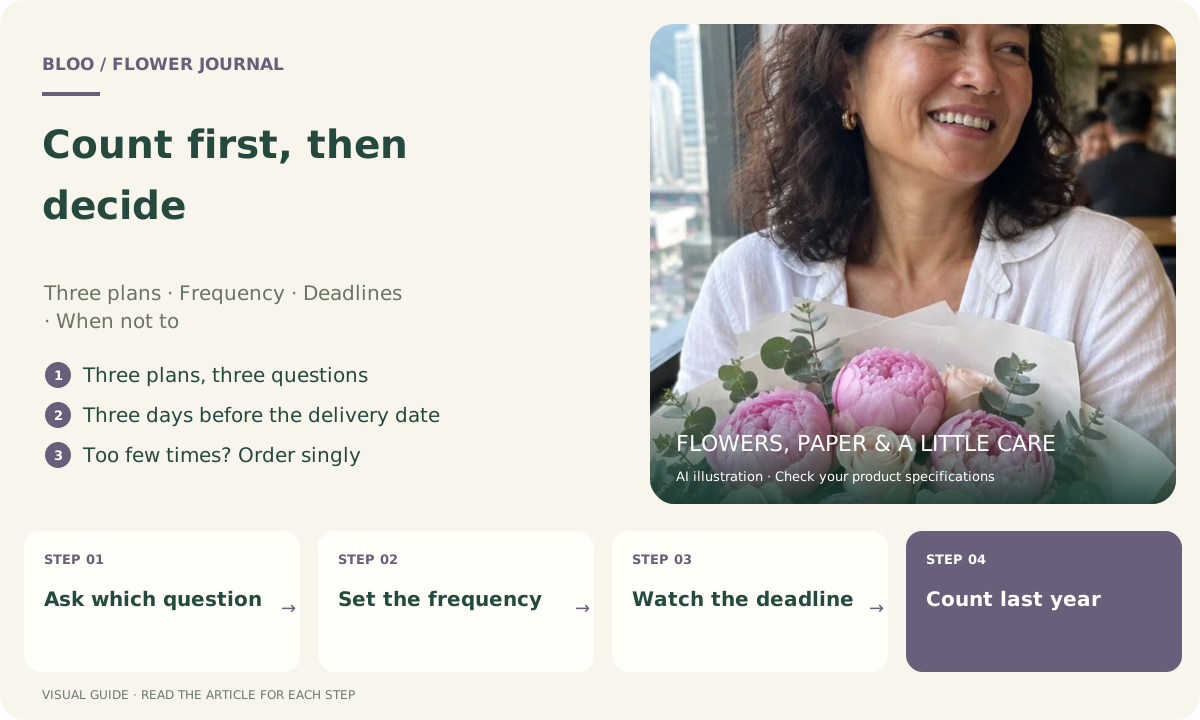
Count first, then decide
Three plans · Frequency · Deadlines · When not to
- 01
Ask which question
All year, a few times, or remembering dates
- 02
Set the frequency
How long you will accept an empty vase
- 03
Watch the deadline
Changes up to three days before
- 04
Count last year
How many you actually sent, not meant to
Check before continuing: Amendment, pause and cancellation follow the status and deadline shown in the account. A delivery already in preparation is locked.
Three plans, answering three different questions
The three exist because customers arrive with three quite different questions. "I want flowers in the house, or in the shop, all year" — that is recurring. "I want to send a few times a year, and one of them should be special" — that is a yearly plan. "I cannot keep the dates in my head" — that is an occasion plan.
Choosing wrong does not so much waste money as produce a plan that does not fit. Using a recurring plan to remember anniversaries means the delivery dates never quite land on the dates that matter. Using an occasion plan to keep a house in flowers means the house is mostly without them. Identify which question you are asking and the choice follows.
| Plan | The question it answers | How it is billed |
|---|---|---|
| Recurring | I want flowers all year. | Billed monthly, cancellable at any time. |
| Yearly | A few times a year, one of them special. | A fixed composition bought up front. |
| Occasion | I cannot keep the dates in my head. | Planned against a budget and a list of dates. |
Choosing a frequency
Recurring runs at three frequencies: weekly, fortnightly and monthly. What decides it is not the budget so much as how often you are willing to have no flowers. A monthly bouquet means a stretch each month with an empty vase. Fortnightly means the next one arrives before the last has quite finished.
The setting matters too. A home can live with an occasional gap; a shop counter or a meeting room cannot, because a vase of spent flowers in front of a visitor is worse than an empty table. That is why business settings usually take weekly — not because the budget is looser.
| Frequency | Deliveries a year | Suits |
|---|---|---|
| Monthly | 12 | A home that can live with a gap. |
| Fortnightly | 26 | Keeping a home in flowers most of the time. |
| Weekly | 52 | A shop counter, a meeting room, or a home that is never without. |
What can still be changed
The usual worry about a subscription is being tied in. The actual rule is that each delivery can be changed up to three days before its Hong Kong delivery date, including the date and the delivery details. Past that point it locks, because the flowers have been secured and the work has started — a practical constraint rather than an administrative one.
The plan itself can be paused, resumed or cancelled. Pausing is not a lock — it can be resumed whenever. After cancelling, deliveries not yet sent are marked as skipped and no further charges follow. And if a bill goes unpaid for long enough, the plan pauses itself rather than letting an unpaid balance keep growing.
- Up to three days before the Hong Kong delivery date: change the date and the delivery details.
- After the deadline: that delivery locks, because preparation has begun.
- Pause: at any time, and resume later.
- Cancel: deliveries not yet sent are marked skipped.
- A long-unpaid bill: the plan pauses itself.
When ordering one at a time is better
This section is the honest part. If you only send two or three times a year — a birthday, an anniversary, Mother’s Day — ordering each one separately is usually better value and leaves you freer. The value of a plan comes from frequency: enough deliveries and the per-delivery cost comes down; too few and the structure is just a constraint you did not need.
Two other situations argue against a plan: a recipient who is often out of Hong Kong, and a home where nobody is usually there to receive. In both, the failed deliveries cancel out whatever convenience the plan was supposed to bring. Better to arrange each one on a date you know they will be there.
Sending to yourself and sending to someone else
A subscription for yourself is about rhythm and variety — something different each time, led by what is in season, and ideally not the same bouquet twice. A subscription for someone else turns on the act of receiving: whether it is convenient for them, whether it starts to feel like an obligation, and whether they have anywhere to put it.
Before giving a subscription as a gift, it is worth asking. A bouquet every fortnight is a delight to some people and a fortnightly task to others. That is not about the flowers but about how someone lives. If you are unsure, send one and see how it lands.
A small check before you decide
Open a calendar and count how many times in the past twelve months you actually bought or sent flowers. Not how many you meant to — how many you did. If the answer is two or three, keep ordering one at a time. If it is eight or more, a plan starts to pay. That number beats any savings calculation, because it is built on what you actually do rather than what you would like to do.
You might also wonder
Can I pause part-way through?
Yes. A plan can be paused and resumed whenever — pausing is not a lock. Individual deliveries can be changed up to three days before their Hong Kong delivery date; past that they lock, because the flowers are secured and the work has started. If you decide to stop altogether, cancelling marks the undelivered dates as skipped.
Will it be the same flowers every time?
No. A plan fixes the size and the tier, while the actual flowers follow what is in season, so each delivery differs. That is part of the point — seasonal material is usually in better condition, and you are not choosing from scratch every time. If there is anything you are allergic to or simply dislike, say so in the preferences.
How far ahead do I need to change an address?
Before the deadline three days ahead of the Hong Kong delivery date. After that the delivery locks, because preparation has begun. If you spot a wrong address after the deadline, contact staff directly rather than assuming the system can still change it.
Sources and further reading
Product specifications, fees and availability follow the details confirmed when ordering. Spotted something that needs correcting? Contact BLOO