 Bouquets · DIY kits
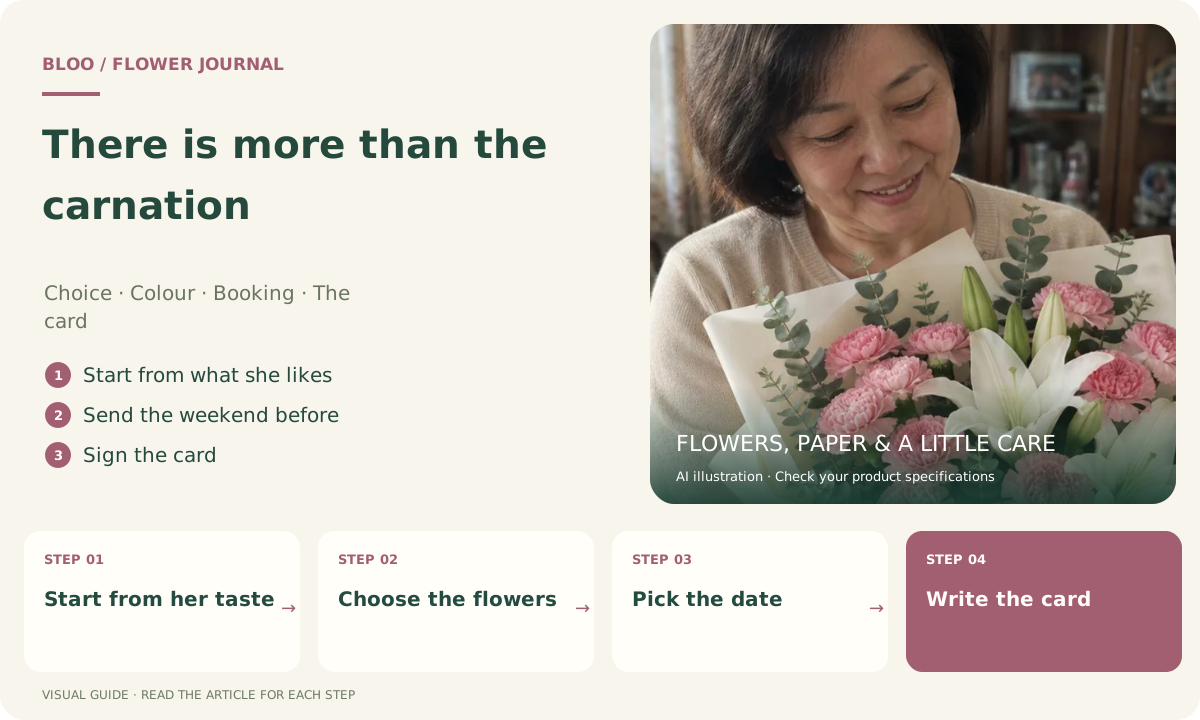
The carnation is the traditional choice but not the only suitable one. Lisianthus, hydrangea, roses, tulips and peonies all work, and the decision should follow what your mother actually likes and where the flowers will sit. On timing, the week before Mother’s Day is among the busiest delivery windows of the year and carries an HK$80 peak surcharge. Sending on the previous weekend is the most practical way to avoid the crush without losing the gesture.
There is more than the carnation
Choice · Colour · Booking · The card
- 01
Start from her taste
The carnation is a habit, not a rule
- 02
Choose the flowers
Consider where it will sit and how much care it needs
- 03
Pick the date
The previous weekend carries no surcharge
- 04
Write the card
A name, and one specific line
Check before continuing: Orders in the week before Mother’s Day carry an HK$80 peak surcharge, charged per order.
How the carnation got the job
The link between carnations and Mother’s Day is not ancient. It comes from the early twentieth-century American Mother’s Day movement, where the founder used her own mother’s favourite white carnations as the emblem; the convention that red is for a living mother and white for one who has died grew up afterwards. It is a habit about a century old, not a rule.
Knowing that is useful because it hands the decision back to you. If your mother likes carnations, send carnations. If she is indifferent to them, or finds them a bit obligatory, a flower she actually likes takes nothing away from the gesture.
Five flowers that work just as well
A Mother’s Day bouquet has practical conditions to meet: it usually sits in a living room or on a dining table, it needs to hold up indoors, and its scent should not be overpowering in a room where meals happen. The following all meet those conditions, with different characters.
| Flower | Character | Care | Suits |
|---|---|---|---|
| Carnation | Traditional, long-lasting, lightly scented | Low | A mother who values the convention. |
| Lisianthus | Rose-like but softer, with a long display | Low | Anyone who prefers elegance over statement. |
| Hydrangea | Voluminous and soft-toned; one stem fills a vase | Medium — thirsty | Homes with a large vase and the space for it. |
| Tulip | Clean lines, and it keeps moving as it opens | Low | Someone who enjoys watching flowers change. |
| Peony | Full heads, a short season | Medium | A special gesture inside its season. |
Colour, and one common misunderstanding
The carnation colour convention — red for a living mother, white in memory of one who has died — still holds in some places but is not universally known in Hong Kong. Send white carnations to a living mother and she may simply read the colour as understated rather than commemorative. Conversely, in a family that does know the convention, the wrong colour can land awkwardly.
The simplest way through is to avoid the pure extremes. A bouquet led by pink, peach or a mix reads warmly under any reading and cannot be misconstrued. If you know the convention is not observed in your family, choose purely on what your mother likes.
The booking calendar and the peak surcharge
The week before Mother’s Day is among the busiest in a florist’s year. Wholesale prices climb beforehand, the popular material sells out early, and both vehicles and hands have to be doubled. Orders in that week carry an HK$80 peak surcharge, charged per order rather than by lifting every bouquet’s price all year.
The most practical way around the peak is to send on the previous weekend. The gesture does not depend on the exact date; a few days early usually means better flowers, more choice and no surcharge. If it must arrive on the day itself, order early and accept that the time slot will be constrained.
| When you send | Choice of flowers | Surcharge |
|---|---|---|
| The previous weekend | Widest choice, and usually the best condition. | None |
| The week before | The popular material starts running out. | HK$80 |
| The day itself | Narrowest choice — order well ahead. | HK$80 |
| Afterwards | Choice returns to normal. | None |
Living together, living apart, or overseas
The hard part is usually not choosing the flowers but the handover. Three common situations, each handled differently. Living together is simplest — bring them home, and you might even arrange them together. Living apart means deciding between delivery to her home and taking them yourself; delivery needs her to be in, or someone to receive.
A mother overseas needs the most planning. Cross-border flowers go through a local florist, so the material and the style follow what is available there and any picture is indicative only. If certainty matters, consider a gift that can be bought locally, or arrange for a relative to hand flowers over during a video call.
Budget and size: bigger is not automatically better
The budget trap on Mother’s Day is converting sentiment straight into volume. An oversized bouquet arriving at a home with one small side table means finding room for it, hunting for a vase large enough, and eventually splitting it into two or three. Bulk can create more work than delight.
Putting the budget into grade and into what is in season usually beats putting it into quantity. For the same money, a correctly sized bouquet of good seasonal material looks considerably better in a home — and lasts a little longer — than a larger one padded out with ordinary stems. When the space is unknown, a medium size is the safe call.
The card, which is the part people skip
Flowers fade and cards do not. Plenty of people leave the card blank at checkout, or write only "Happy Mother’s Day", and the recipient is then unsure who sent it — particularly in a family where several siblings might have. A card should carry at least a name, and ideally one specific sentence.
One specific line beats an elaborate one. Something that actually happened this year, a detail you remember, a sentence you do not usually say out loud — any of these outlasts a generic greeting. It does not need length; two or three lines is plenty.
A small check before you order
Picture where the bouquet will actually sit in her home: the coffee table, the middle of the dining table, or the kitchen windowsill. Then look at how much room that spot has, whether there is already a vase for it, and whether an air-conditioning vent or direct sun reaches it. That question settles far more than any flower meaning does — size, material and how much care it will need all follow from it.
You might also wonder
Is a few days before Mother’s Day still enough time?
Usually yes, but the choice narrows, the popular material may already be gone, and orders that week carry an HK$80 peak surcharge. For the best condition and the widest choice, sending on the previous weekend is more practical — and carries no surcharge.
Better to send to her office or her home?
It depends on where she will be and whether she minds receiving flowers in front of colleagues. An office guarantees someone is there, but she has to carry the bouquet home. A home address needs her to be in, or someone to take it. Mother’s Day falls on a Sunday, so home is usually the better answer.
Does the carnation colour really matter?
In some places the convention still holds — red for a living mother, white in memory of one who has died — but it is not universally known in Hong Kong. If you are unsure whether your family observes it, pink, peach or a mix is safest: it reads correctly under any interpretation.
Sources and further reading
Product specifications, fees and availability follow the details confirmed when ordering. Spotted something that needs correcting? Contact BLOO