 Bouquets · DIY kits
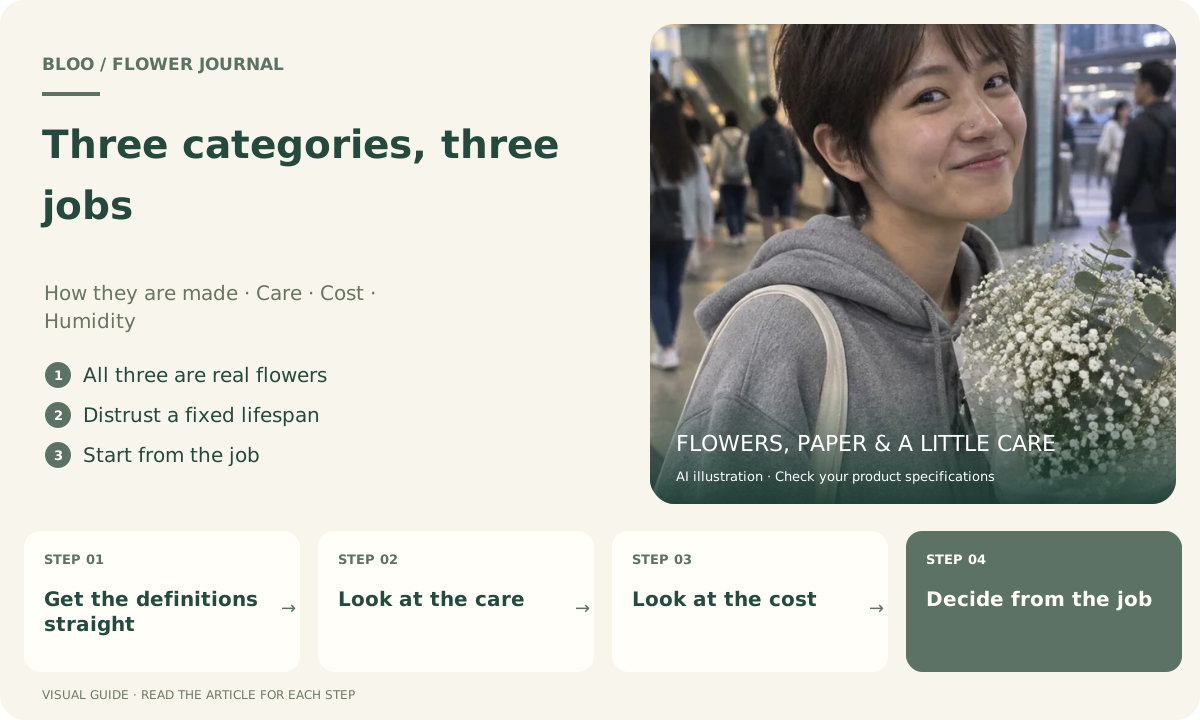
Fresh flowers are untreated cut stems that need water and trimming, and are enjoyed over days to weeks. Dried flowers are air- or heat-dried, feel brittle, and need no water. Preserved flowers — sometimes called everlasting — are real flowers that have been dehydrated, refilled with a preserving solution and usually dyed; they feel close to fresh but take no water. These are not better and worse, they are three different jobs. BLOO sells fresh, so what follows includes the things preserved flowers do that we cannot.
Three categories, three jobs
How they are made · Care · Cost · Humidity
- 01
Get the definitions straight
Fresh, dried and preserved are processed differently
- 02
Look at the care
Watering, or keeping dry
- 03
Look at the cost
Recurring, or paid once
- 04
Decide from the job
Where do you want it a month from now
Check before continuing: The three-to-ten-year figure comes from the preserved-flower trade, not from BLOO testing. BLOO does not promise a fixed vase life for fresh flowers either.
Three categories, defined
The three terms get used loosely in the market, and one shop will sometimes call the same product two different things. Defining them first makes the comparison mean something. What they share is that all three start as real flowers. What separates them is what happened after they were cut.
One more product deserves a mention because it sits alongside these on the shelf: soap flowers. They are not flowers at all, but soap sheets pressed into flower shapes, usually for gift boxes. They keep indefinitely and cost little, but they are not flowers — worth knowing if the point of the gift is to send flowers.
| Category | How it is made | Real flower | Needs water |
|---|---|---|---|
| Fresh | Cut stems, untreated. | Yes | Yes |
| Dried | Air-dried or heat-dried. | Yes | No |
| Preserved | Dehydrated, refilled with a preserving solution, usually dyed. | Yes | No |
| Soap flowers | Soap sheets pressed into shape. | No | No |
How a preserved flower is made
Making a preserved flower runs roughly four steps: bleach out the original colour, draw off the water in the petals, replace that water with a preserving solution — usually glycerine-based — so the petals stay soft, and then dye them back to colour or to a new one. The process takes time and equipment, which is the main reason the unit price is high.
Because they are dyed, preserved flowers come in a far wider colour range than fresh ones, including blues and fluorescent tones that do not occur naturally. That is both a selling point and a tell: a colour that does not exist in nature has certainly been processed. Not a fault — just something that should be said out loud.
How long they last, and why neither side should quote a number
Sellers of preserved flowers commonly quote three years, and five to ten with good care. That range comes from the trade rather than from any testing of ours, so we are relaying it rather than endorsing it. In practice humidity, light and handling move the outcome a great deal, and the same batch behaves differently in two different homes.
On the fresh side, BLOO does not promise a fixed number of days either. Variety, how open the bloom was when cut, transit time and the conditions indoors all change the result. Any hard figure — whether it is seven days guaranteed or ten years guaranteed — deserves the question: under what conditions does that number hold?
Hong Kong humidity is a real factor
Hong Kong’s mean relative humidity runs high year-round, and the spring damp can push it close to saturation. The preserving solution in the petals is hygroscopic, so in sustained high humidity preserved flowers can soften, lose colour or spot at the petal edges. That is not a defective product; it is how this product behaves in this climate.
What to do about it: keep them somewhere air-conditioned or dehumidified, away from windows and bathrooms, and out of direct sun, which fades the dye faster. A glass dome helps, though sealing is not automatically safer — a dome that traps damp air is worse than none.
The cost sits in different places
Fresh flowers carry their cost in the stems and the hand work, and that cost recurs every time. Preserved flowers carry theirs in the processing: a high unit price paid once. That difference sets how each is used — fresh flowers are a gesture that repeats, preserved flowers are a keepsake bought once.
Put concretely: across six occasions in a year, fresh flowers accumulate a total, while a single preserved arrangement is one outlay. But that one arrangement does not appear in front of someone on six separate days. The number of times a gesture happens and the lifespan of an object are different things, and it is worth knowing which one you are buying.
| Fresh | Preserved | |
|---|---|---|
| Cost sits in | Stems and hand work | Processing |
| Payment pattern | Recurs each time | Paid once |
| Daily care | Water changes and trimming | Keep dry, keep out of light |
| Best for | A gesture that repeats — festivals and anniversaries | A keepsake — preserving a wedding bouquet |
Choosing: start from the job
Do not ask which is better; ask what this bouquet is for. If the point is that someone feels remembered on a particular day, the immediacy and the scent of fresh flowers are things preserved ones cannot do. If the point is to hold on to a moment that has already happened — a wedding bouquet, the first flowers you ever gave — that is exactly what preserving is for.
Flowers for an older relative is the case that comes up most. If they live somewhere air-conditioned, have limited mobility or would rather not change water daily, preserved or dried is the practical answer. If they enjoy looking after plants and find the trimming and water-changing satisfying, fresh flowers are the more welcome gift. The answer is in the person, not the flower.
A small check before you order
Ask yourself one question: a month from now, where do you want this bouquet to be? If the answer is "gone, but they were happy that day", choose fresh. If it is "still on the shelf in the living room", choose preserved. Both answers are fine, but they point at different products — and most people who choose wrong simply never asked.
You might also wonder
Are preserved flowers real flowers?
Yes. They are real flowers put through four steps — bleaching, dehydration, replacement of the water with a preserving solution, and dyeing — which is why they feel close to fresh but take no water. Worth distinguishing from soap flowers, which are soap pressed into flower shapes and are not flowers at all, though the two often sit side by side in gift ranges.
Does Hong Kong weather affect preserved flowers?
Yes. Humidity here runs high year-round and peaks in the spring damp, and the preserving solution is hygroscopic, so sustained damp can soften the petals, dull the colour or cause edge spotting. Keeping them in air-conditioned or dehumidified rooms, away from windows, bathrooms and direct sun, is the practical answer.
Which suits an older relative?
Look at how they live rather than at the flowers. If mobility is limited or daily water changes would be a chore, preserved or dried is more practical. If they enjoy tending plants and find the trimming satisfying, fresh flowers are the more welcome gift. Scent matters too — strongly perfumed material such as lilies does not suit everyone.
Sources and further reading
Product specifications, fees and availability follow the details confirmed when ordering. Spotted something that needs correcting? Contact BLOO