 Bouquets · DIY kits
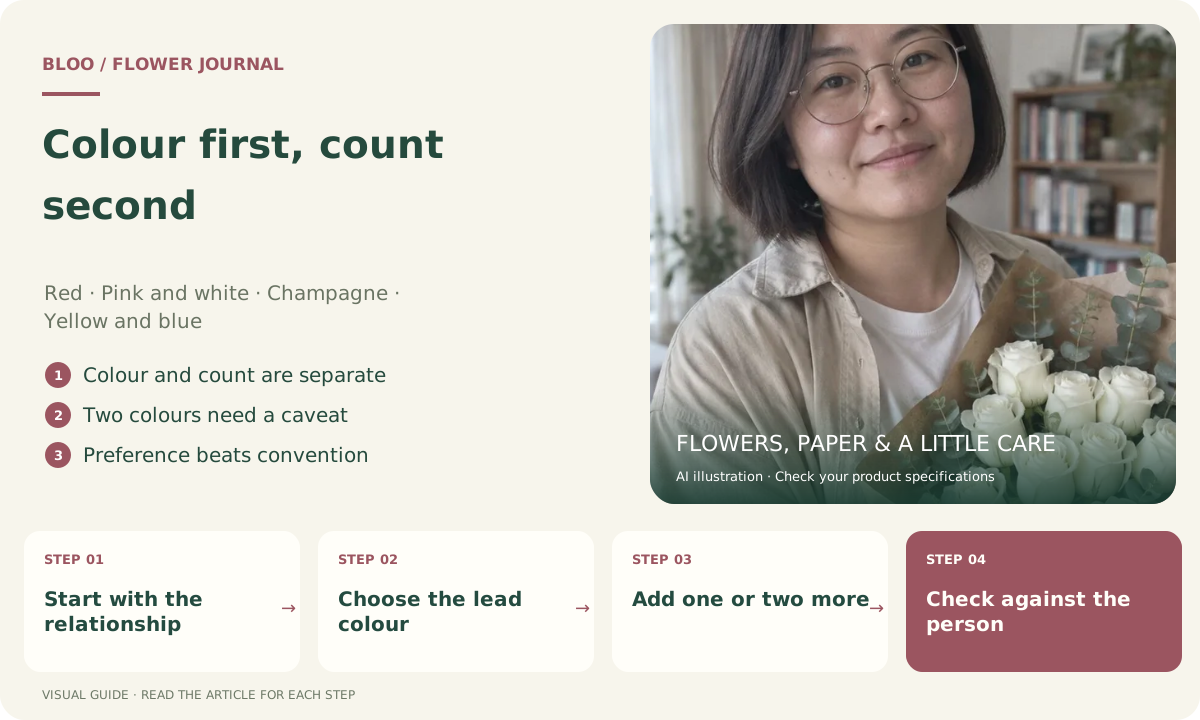
Red roses read as open romantic love, pink as affection and appreciation, white as respect and sincerity, champagne and cream as settled long-term affection. Yellow carries two readings in Chinese-speaking contexts and depends on the setting. These are cultural conventions, not rules, and what the recipient actually likes outranks all of them. Colour and stem count are separate choices that do not need to be traded against each other.
Colour first, count second
Red · Pink and white · Champagne · Yellow and blue
- 01
Start with the relationship
What the bouquet is actually saying
- 02
Choose the lead colour
Let the dominant colour carry the message
- 03
Add one or two more
Neighbours for depth, never in equal measure
- 04
Check against the person
What they have said they like comes first
Check before continuing: Flower meanings summarise cultural habit rather than setting rules. What the recipient has actually said they like comes first.
Colour and stem count are two separate questions
Most gifting guides fold colour and stem count together, and answer neither well. Stem count works through number homophones in Chinese custom — one, eleven and ninety-nine each have a reading. Colour works on the intensity of the feeling and the nature of the relationship. They are independent: eleven white roses and eleven red roses carry the same number and say quite different things.
In practice, choose the colour first and the count second. Colour settles whether the bouquet reads as a declaration, a thank you or a mark of respect. Count settles the scale and the budget. Deciding colour first makes everything after it easier.
Red: the most direct, and the hardest to walk back
Red is the one colour almost nobody misreads: it states romantic love. That clarity is exactly why it does not suit an undefined relationship. Sending red roses to someone you are still feeling your way with defines the situation on their behalf, and they may not be ready for that.
Red is not a single colour either. Deep, wine-toned reds read as settled and restrained. Bright true red is direct, and is what most festivals and proposals use. If the recipient dislikes being conspicuous, the deeper red is the safer choice.
Pink and white: they fit more occasions than you would think
Pink is the most broadly usable colour. Pale pink reads as appreciation, gentleness and early affection; deeper pink leans towards gratitude. Because it carries none of red’s pressure, pink works for birthdays, graduations and thank-yous, and for relationships still finding their shape.
White roses are often assumed in Chinese-speaking contexts to belong only at funerals. In fact they are just as common at weddings, in apologies and wherever respect is the point. The difference is in the styling: white roses with foliage and light wrapping read as clean and fresh, while an all-white bunch in plain wrapping is what reads as mourning in some settings. If that worries you, a little pink or champagne in the mix settles it.
Champagne and cream: the most underrated choice
Champagne roses sit between cream and pale gold, and have become one of the most popular colours in Hong Kong. They read as settled and quiet, which suits established relationships — a wedding anniversary, a parent’s birthday, a colleague of many years. Where red announces, champagne says something closer to "still here".
It is also the easiest colour to build around. It sits well with foliage, with dried material and with dark wrapping paper, it does not blow out in photographs, and it does not go muddy under indoor light. When in doubt about someone’s taste, champagne is the least likely to misfire.
Yellow and dyed blue: the two that need a caveat
In Western convention yellow reads as friendship and good wishes; in parts of Chinese-speaking convention it can carry a sense of parting or apology. Both readings are real, so yellow is not unsendable — it just depends on the relationship. To a friend, a colleague or a parent it is usually fine. To a partner, consider how they will read it. If they simply like yellow, asking beats guessing.
Blue roses, and some purple ones, are dyed rather than natural varieties. That is worth saying plainly — not because dyeing is a problem, but because a customer is entitled to know what they are buying. Dyed petals can show variation at the edges, which is normal and not a fault in the flower.
Mixing colours without making a mess
Mixed bouquets are easy to like and easy to overdo. The safest approach is one dominant colour with one or two neighbours supporting it, rather than three or four contrasting colours in equal measure. Red with deep pink, pink with champagne, white with pale green are all low-risk.
If you want a mixed bouquet still to carry a message, let the dominant colour do the talking and the others provide depth. A bouquet that is mostly red with a little white and champagne still reads as red roses; it simply looks less flat.
| Colour | Commonly read as | Suits | Think about |
|---|---|---|---|
| True red | Stated romantic love | A partner, a proposal, an anniversary | Moves too fast for an undefined relationship. |
| Deep red | Settled, restrained affection | Long-term partners, anyone who dislikes fuss | Reads darker under indoor light. |
| Pale pink | Appreciation and gentleness | Birthdays, graduations, thank-yous | Too gentle if you mean to be clear. |
| White | Respect and sincerity | Weddings, apologies, elders | All-white in plain wrapping reads as mourning in some settings. |
| Champagne / cream | Quiet, lasting affection | Anniversaries, elders, colleagues | Almost risk-free; the default when unsure. |
| Yellow | Friendship and good wishes, or parting and apology | Friends, colleagues, anyone who likes yellow | Consider how a partner will read it. |
The recipient outranks the convention
Flower meanings are a summary of cultural habit, not a rulebook. They are useful for anticipating how someone might read a bouquet and for avoiding an obvious misstep. They stop being useful the moment the recipient does not think in those terms, at which point following the convention just delivers flowers they do not like.
The working order of priority is: what they have actually said they like, then what suits the occasion, then the convention. If you know they love sunflowers, send sunflowers. If you know they dislike the scent of lilies, do not send lilies because lilies are "appropriate".
A small check before you order
Write down who it is for, what the occasion is, and the one sentence you would say if you were there. Then check the colour against it. If the sentence is "I want to be with you", red matches. If it is "thank you for these years", champagne or pink fits better. If it is "congratulations", the colour can relax — bright is enough. If you cannot write the sentence, that usually means the choice is not settled yet.
You might also wonder
Is yellow really off-limits?
No. Yellow reads as friendship and good wishes in Western convention, and only in parts of Chinese-speaking convention carries a sense of parting or apology. To friends, colleagues and elders it is usually fine. To a partner, think about how they will read it — and if they simply like yellow, that matters more than any convention.
Does a mixed bouquet look less thought through?
Not if one colour leads. A dominant colour with one or two neighbours for depth still reads clearly. What loses focus is three or four contrasting colours in equal measure — no theme, and nothing to read.
What if they do not like roses?
Then do not send roses. Roses are the most-sent flower, not the most suitable one for everyone. The colour logic transfers — tulips, carnations and sunflowers all come in the same range. What someone has actually said they like always comes before the convention.
Sources and further reading
Product specifications, fees and availability follow the details confirmed when ordering. Spotted something that needs correcting? Contact BLOO